
Carter County - Introduction to Layers
Background Info / Historical Story
“About the time that Montana became a state, a new branch of science dealing with fossils was creating interest among a few large museums and universities, and small groups of scientists were taking to the field to collect evidence of life of the past. Geologists were finding that they could use fossils to help identify and correlate geologic strata and to help determine their geologic histories. Biologists were using them to trace the evolutionary histories of living things. The public at large was intrigued with the immensity of geologic time and with the direct evidence of the size and variety of animals that once lived on this earth. So began the organized search for fossils.” - Shifting Scenes Volume 2, Marshall E. Lambert 1976
“There are few geologic formations more recent than Oligocene time of 35 million years ago in southeastern Montana, and even the Oligocene exposures are very limited, as erosion has been continually reducing their extent. The major drainage systems have been cutting down through their own flood plains and stream bed gravel deposits of the last tens of thousands of years exposing a few fossil bones, mostly nonmineralized, of animals that lived here as recently as eight to ten thousand years ago. These Pleistocene animals include two elephant forms, the mammoth and the mastodon, camel, horse and extinct species of bison, all of which became extinct in North America by the end of the Pleistocene epoch. Bones and teeth of these animals are found today along the stream beds of the Little Missouri River, Box Elder, Beaver and O’Fallon Creeks in southeastern Montana. The erosional work of wind and running water continues to expose new surfaces of all geologic formations, each with its characteristic fossil forms; and paleontologists, both professional and amateur, collect and prepare these fossils for the stories they have to tell.”- Shifting Scenes Volume 2, Marshall E. Lambert 1976
Item from Collections
- Excerpt from CCM exhibit
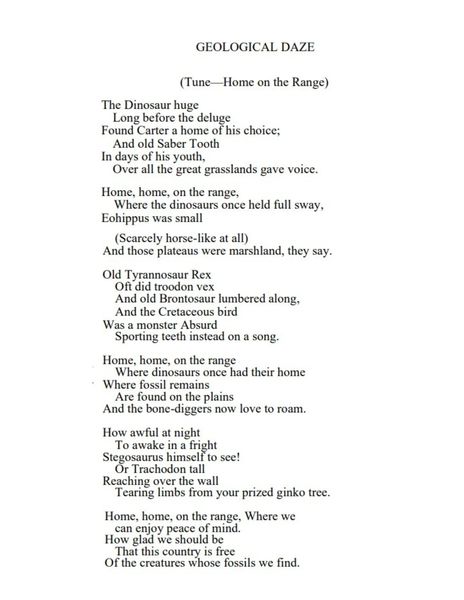
- Founders Day Theme Song, Written for annual program by the Carter County Geological Society (CCGS)

Photos, Maps, etc
- Montana-Geologic-Map-2000px-2
- CC GEO
- Plastering a Fossil
- DeLoss Hall

