
Carter County - Indigenous Science and Paleontology
Background Info / Historical Story
Indigenous stories are intrinsic to Montana history. Despite this undeniable connection, Indigenous peoples’ science and histories have often been disregarded. Carter County students have an amazing opportunity to learn about and appreciate local history through the lens of Indigenous science and culture.
A fundamental tenet of Indigenous Science is sustainability and preserving balance. There are, unfortunately, many examples in western history where these concepts are violated. In the late 1800s there was a push by the U.S. government to kill as many buffalo as possible. This was done to destabilize the Plains Indians’ way of life. There are countless examples of the colonization of the Americas leading to the extinction or near-extinction of native animal species. Whether done through ecological ignorance or malice, the dismissal of Indigenous Science has created lasting effects on the Montana landscape and Indigenous culture.
Below are a selection of excerpts from Shifting Scenes: Volume 2 that highlight stories of Ijkalaka and her husband within the context of the buffalo slaughter that took place in Eastern Montana.
“Reports indicate that from 170,000 to 200,000 [buffalo] hides, all from what was then Custer County, were shipped from Fort Keogh in the year 1882, with considerably less the following year and the last of the buffalo on the range were seen in 1885 when an occasional stray was seen. The purpose of the Military people to slaughter the buffalo and thus subdue the Indians by depriving them of their source of food was accomplished.”- H. B. Albert, Shifting Scenes
“The Indians were usually very careful in preserving their source of food and killed buffalo only for their own requirements using not only the meat and hides but also some of the bones from which they fashioned various tools.”- H. B. Albert, Shifting Scenes
“Mr. Russell was married at or near Fort Laramie, Territory of Wyoming on February 16, 1874. He married Ijkalaka, an Oglala Sioux girl, daughter of Eagle Man and she was born around 1856 on Powder River in Wyoming. Her name, Ijkalaka, in her native tongue means to pick up and move. Walter H. Peck (an Ekalaka resident) told in a letter he had written to a friend that Mr. Russell had given his wife’s father eight horses and a one hundred pound sack of sugar, and sugar in those days of high freight costs was very valuable, in return for his daughter’s hand.”- Vivian Castleberry, Shifting Scenes
“David Russell then came to eastern Montana in 1881 as a buffalo hunter and with his wife and four children settled four miles southeast of what is now Ekalaka. (Mr. Russell said that he had first seen the location, a beautiful valley at the edge of the forest, about fifteen years earlier while on a buffalo hunt with Chief Joseph.) Here they made their home and raised their family.”- Vivian Castleberry, Shifting Scenes
"Father heard about the buffalo in Montana and what the government was going to do about these buffalo. He sold the ranch and most of the stock, only a few head to take to Montana, which was a few cows and horses, with us. Stock raising was his business while we lived in Wyoming. He heard that the government had sent out word for anybody that wanted to hunt buffalo was to go to Montana and kill off all the buffalo they could. We had word from the United States Army to do this, as long as there were buffalo on the range they (Indians) could live and fight. This is our only show to conquer them, is by killing off all the buffalo. This is why the government made this call, and the hunters could keep the hides of what they killed, but they must be killed off. This is one reason why the great herds of buffalos were exterminated in Montana by the government request to do so, to take away the poor Indians only living they knew.” - James Russell, Shifting Scenes
“In company with Isaac Downing, Mr. Russell killed 2,650 buffalo during the winter of 1881-1882 and sold the hides. In the spring of 1883 he shipped 19,000 hides and skins out of this region.”- Vivian Castleberry, Shifting Scenes
“I can remember seeing many a head of buffalo passing close by our home, a beautiful sight I must say to see these great herds of buffalo pass through, but it wasn’t but a few years until these great herds began to get scarce. Once in a while you would see thousands and thousands of buffalo carcasses laying all over the country where you had a mind to look. Just killed for their hides, and what a dirty shame the way these noble animals were slaughtered by the thousands by the white man....” - James Russell, Shifting Scenes
Collections Spotlight
Photos, Maps, etc
- Ijkalaka David and Daughter
- Russel Ranch
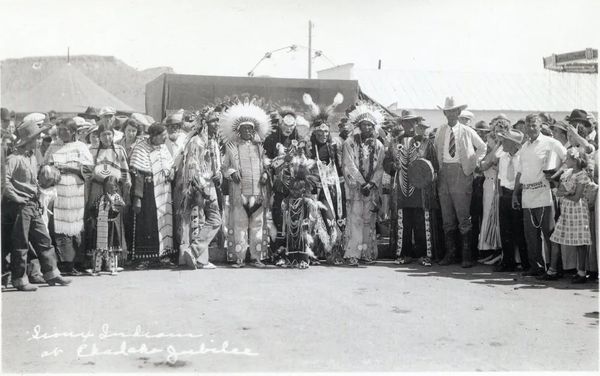
- 1935 Sioux Tribal Members at Ekalaka Jubilee
- Carter County Geologic Map
- Bison at Medicine Rocks
- Buffalo Bone pile near Anaconda
Links to other helpful sources:
- Foreshaft made of mammoth bone found at Mill Iron Site - Illustration
- Great American Buffalo Slaughter | History | Research Starters
- An Illustrated Guide to latest Cretaceous Vertebrate Microfossils of the Hell Creek Formation of northeastern Montana