
Boarding Schools in Montana
9-12th Grade Social Studies
Content Topics
- Montana History
- Native American Studies
Duration Two days -- Day 1 45 min, Day 2 is 60
Objective:
Students will learn about the history of Native American boarding schools and their short to long term consequences.
Overview and Purpose:
The primary purpose of Native American boarding schools was to forcibly assimilate Native American children into mainstream American culture. This meant suppressing their native languages, religions, and cultural practices. The motto "Kill the Indian, Save the Man" is often associated with this era, reflecting the intent to eradicate Native American identities.
Some of the key features include the separation of families, where children were often removed from their families. Their languages were not allowed to be spoken, along with their traditional clothing, hairstyles, and traditional practices were prohibited.
Many of these schools were overcrowded. Students endured physical and emotional abuse. They were often malnourished and had inadequate medical care. Many of the schools were run by religious organizations, and students were often subjected to religious indoctrination.The impact of these schools has left intergenerational trauma, and loss of language and culture, and the erosion of family structures within the Native American communities.
Guiding Questions:
- What are the long-term consequences of the boarding school era for Native American communities?
- How are Native American communities working to reclaim their languages and cultural traditions today?
- What role can education play in promoting understanding and reconciliation between Native American communities and the broader society?
- What were the main goals of the U.S. government in establishing boarding schools for Native American children, and how did these schools attempt to achieve these goals?
- How did the boarding school experience impact the lives of Native American students, their families, and their communities?
- How are Native American communities working to recover from the historical trauma caused by boarding schools and preserve their cultural heritage today?
Education Standards:
- SS.H.9-12.10 Analyze perspectives of American Indians in US history.
- SS.H.9-12.5 Explain events in relation to both their intended and unintended consequences, including governmental policies impacting American Indians.
- SS.H.9-12.13 Integrate evidence from multiple relevant historical sources and interpretations into a reasoned argument about past and present people, events, and ideas.
Materials and Resources:
- Boarding School Presentation
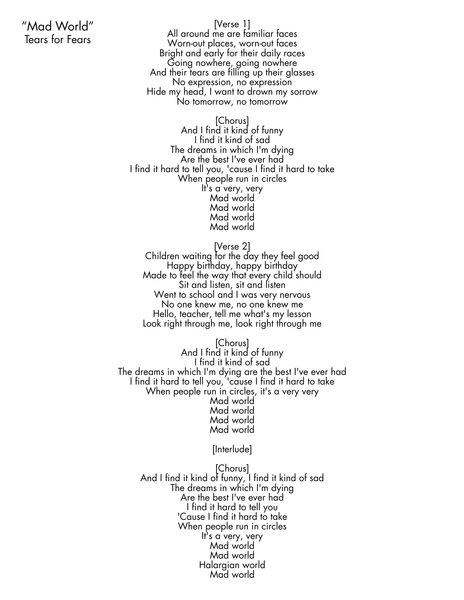
- Mad World Lyrics
Local Resources:
Part 1 (45 Min)
Introduction/Hook:
- Display the title slide from the Presentation - Native American Boarding Schools in Montana.pptx
- Ask: What do you know about Native American boarding schools?
- Have students write a short response or discuss in pairs.
Presentation:
- Present key slides from the PowerPoint on the history, purpose, and impact of Native American boarding schools.
- Highlight schools in Montana (e.g., St. Ignatius Mission School, Fort Belknap Indian School, St. Labre).
- Discuss government policies and assimilation tactics.
Discussion:
- Divide students into small groups. Assign each group a specific aspect of boarding school experiences (e.g., cultural suppression, physical and emotional abuse, family separation).
- Have them analyze their assigned aspect and share their findings.
Exit Ticket
- Ask students to write one question they still have about boarding schools.
Part 2 (60 Min)
Activity:
Play Mad World by Tears For Fears while students listen and read the lyrics.
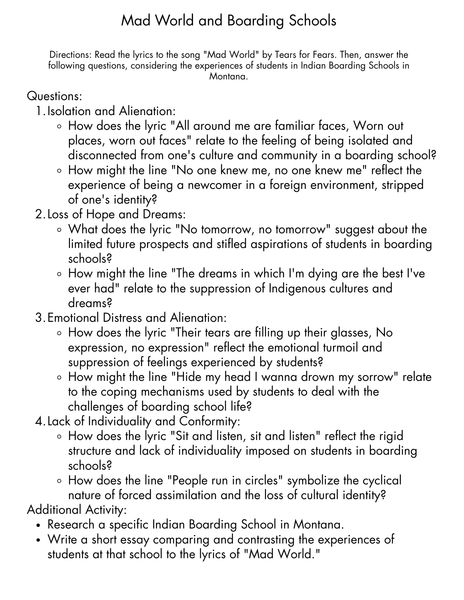
Lyric Analysis
- In pairs, students answer discussion questions from Mad World and Boarding Schools handout.
- Whole-class discussion on how the song reflects the emotional experiences of Native American boarding school students.
Essay Activity
- Students research a specific boarding school in Montana.
- Write a short poem or journal entry from the perspective of a boarding school student.
Closure & Reflection
- Discuss modern efforts for healing and reconciliation (from Presentation).
- Ask: What can be done today to preserve Native American cultures and languages?
Differentiation
Boarding School Through the Eyes of a Student
Differentiated Activity:
Students will empathize with the experiences of Native American students who attended boarding schools by creating a fictionalized account.
Differentiation: This activity offers flexibility for students with varying learning styles and needs.
Tier 1 (All Students):
- Research: Students research a specific Montana boarding school (St. Ignatius Mission School, Fort Belknap Indian School, etc.)
- Creative Writing: Students write a fictionalized journal entry or a short story from the perspective of a student attending that boarding school.
- This should include details about their daily life (classes, meals, chores), their feelings and emotions (loneliness, fear, anger, hope), and their experiences with cultural suppression.
- Reflection: Students reflect on the challenges faced by boarding school students and the impact of these experiences on their lives and communities.
Tier 2 (Students who need additional support):
- Simplified Research: Provide students with a simplified resource sheet or a shorter reading about a specific boarding school.
- Alternative Creative Expression: Allow students to express their understanding through other creative mediums, such as:
- Drawing or painting: Create a visual representation of a day in the life of a boarding school student.
- Songwriting: Compose a song or poem that reflects the student’s experiences.
- Drama: Create a short role-playing scenario depicting a scene from a boarding school.
Tier 3 (Students who need enrichment):
- Extended Research: Encourage students to research the experiences of specific individuals who attended boarding schools in Montana. They can use primary sources (if available) such as memoirs, oral histories, or archival documents.
- Advanced Writing: Students can write a longer piece of creative writing, such as a short story or a longer reflective essay, exploring the psychological and emotional impact of the boarding school experience.
- Research Presentation: Students can present their findings and creative work to the class, incorporating multimedia elements such as images, videos, or audio recordings.
Assessment
- Tier 1 and 2: Evaluate the creativity and depth of the student’s chosen expression (writing, drawing, song, etc.). Assess their understanding of the challenges faced by boarding school students.
- Tier 3: Evaluate the depth of research, the quality of the creative work, the effectiveness of the presentation, and the student’s ability to analyze and communicate their findings.
- Participation in discussions.
- Responses to Mad World analysis.